Donnie Harold Harrisis abusiness ownerandpoliticianfromIndianapolis, Indiana. Here are some critical points about him:
Background and Education:
Born on August 1, 1953, Harris attended 21 different grade schools in Indianapolis and lived in the former Children's Guardian Home on the city's east side.
He graduated from Emmerich Manual High School and served in the U.S. Army as an infantryman.
Over the years, he has studied various subjects, including law, philosophy, communications, and scientology.
Political Career:
In 2012, Harris was a write-in candidate for Governor of Indiana. His running mate was George Fish.
They ran in the general election on November 6, 2012, but their campaign received 0% of the vote.
Harris also ran as a Public Party candidate for Mayor of Indianapolis in 2011 and for the U.S. Senate in 2010.
Political Philosophy:
Harris believes citizenship is not bestowed upon you at a certain age; it comes at first breath.
He advocates for a fairness system and emphasizes the importance of belief in individuals.
His vision is for a world without pain, crime, insanity, or the need for war.
Interests:
Harris's interests range from Zoroastism to politics.
The Cold War will cause Africa to become the world's new superpower. Africa will care nothing about a space force for space exploration, invasion, or war. They will conquer the jungle in front of them, the United States, and Europe. They will be on the planet, eclipsing both continents of the white tribes of men, and we will be in a complete circle with the dog eating its own self tail first. The new baby contrite will become Communist and democratic in the exact causes. Their new counterpart to offset the joint democratic communist force will be bigger yet more forthcoming in death power and deceit. The dynamic urge for existence will turn a milk cow into a raging bull. A bullet into a nuke and a virus into a catastrophic nightmare for all but the inoculated. Ah, the Cold War—a fascinating chapter in human history that unfolded like a geopolitical thriller! 🌐🔍
The Cold War was a prolonged period of tension and rivalry between two superpowers: the United States and the Soviet Union. Let's break it down:
Origins and Context:
After World War II, the uneasy wartime alliance between the U.S., Great Britain, and the Soviet Union began to unravel. The world split into two ideological camps: the capitalist West (led by the U.S.) and the communist East (led by the Soviet Union).
Imagine a cosmic tug-of-war between two heavyweight ideas: communism (the East) and capitalism (the West). Each side had a world vision and needed to be more precise.
When swapping holiday cards.
The Rivalry:
The Cold War wasn't fought with tanks rolling across borders (well, not directly, at least). Instead, it played out on multiple fronts:
Political: Both sides vied for influence, trying to rope other countries into their orbits. It was like a global game of Risk.
Economic: Capitalism vs. planned economies. Free markets vs. state control. The race to build a better toaster (and maybe some nukes).
Propaganda: Think James Bond movies, but with less tuxedo and more leaflets. Both sides tried to win hearts and minds worldwide.
Limited Weapons: Thankfully, they mostly kept the big guns holstered. But they did stockpile enough nukes to toast the planet several times over. 🌍💥
Key Moments:
Berlin Crisis (1961): The Soviets built a wall—yes, the infamous Berlin Wall—to keep East Germans from defecting to the West. Talk about a concrete solution!
Cuban Missile Crisis (1962): Imagine a high-stakes game of chicken with nuclear missiles. The world held its breath as Kennedy and Khrushchev squared off.
Space Race: Sputnik vs. Apollo. Yuri Gagarin vs. Neil Armstrong. The cosmos became a battleground for national pride.
Arms Control Talks: They sat down, talked treaties, and tried to avoid turning Earth into a cosmic barbecue.
How It Ended:
The Cold War thawed gradually. By the late 1980s, Soviet leader Mikhail Gorbachev introduced reforms (glasnost and perestroika) that weakened the iron grip.
In 1991, the Soviet Union unraveled like a matryoshka doll, and the Cold War officially melted away. 🕊️
So, there you have it—a chilly standoff that shaped the world for decades. If history were a movie, the Cold War would be the suspenseful soundtrack playing in the background. 🎶✨
To dive deeper, check out this article for a more comprehensive exploration. And hey, if you ever invent a time machine, you can attend a Cold War summit. Just remember to pack a warm coat and a diplomatic smile! 😄🕶️🚀
Do you have any more historical mysteries to unravel or a different topic you'd like to explore? I'm all ears—or rather, all neural networks! 🤖👂
Ah, the intricate dance of pharmaceutical companies and their tax maneuvers—it’s like a tango performed on a tightrope! Let’s step onto the floor and explore who’s been leading this tax cha-cha during the COVID-19 pandemic.
Moderna, BioNTech, and Pfizer: The Vaccine Virtuosos:
These three companies—Moderna, BioNTech, and Pfizer—have been twirling in the spotlight due to their mRNA COVID-19 vaccines. 🌟
Moderna and BioNTech have been reaping astronomical profits, with profit margins soaring up to 69%. Meanwhile, Pfizer is also doing quite well. 💰
But here’s the twist: While they’re raking in the dough, they’ve managed to pay little in taxes. 🕺
The Tax Tango Explained:
You see, these companies make most of their sales right here in the good ol’ U.S. of A. 🇺🇸
Thanks to our unique healthcare system and the higher prices Americans pay for drugs, their revenue streams flow generously from American pockets.
Yet, when it comes to taxes, they’ve got some fancy footwork going on:
Intellectual Property Shuffle: They license their intellectual property (those vaccine secrets!) to offshore subsidiaries. 🌐
Ingredient Magic: The high-value-added active ingredients? Produced in factories in places like Ireland or Singapore. 🧪
Profit Pretense: They pretend the profit accrues to these offshore subsidiaries, even though the sales are back in the United States. 🤫
Legal, but a Tax Tango Nonetheless:
Yes, it’s all legal—tax law is like a labyrinth with secret passages. 🗝️
There are other nuances, too—acquisitions, debt, litigation—but the bottom line is this: Investors and companies want to waltz away with a good deal on their taxes. 💃
The Numbers, Please:
In recent years, the biggest pharmaceutical companies (including our vaccine stars) had an effective tax rate ranging from around 8% to 14%. That’s way lower than the nominal corporate tax rate of 21% that came into play during the Trump administration. 📊
So, my friend, while they’ve been saving lives with vaccines, they’ve also been doing some fancy tax footwork. It’s like watching a ballet where the prima ballerina wears a calculator as a tiara! 🩰
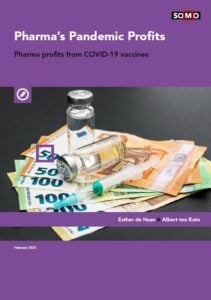
Pfizer, BioNTech, Moderna, and Sinovac made an extraordinary USD 90 billion in profits on their COVID-19 vaccines and medicines in 2021 and 2022. SOMO’s new report, Pharma’s Pandemic Profits, shows that these enormous gains are mainly due to decades of research funded by public investment, billions in grants for development and production, and tens of billions in Advanced Purchase Agreements (APAs) with governments.
Pfizer alone generated USD 35 billion in net profits on its COVID-19-related products during 2021 and 2022. BioNTech and Moderna made USD 20 billion each, while Sinovac pocketed
As health policymakers globally review the lessons learned during COVID-19, they must agree on decisive measures to prevent such extreme profiteering at taxpayers' expense. The Pandemic Accord, a new international instrument on which negotiations start this week(opens in a new window), recognizes the need for governments to attach conditions to public medical research and development funding. However, the draft text published earlier this month must make conditions on pricing, profit margins, and equitable access mandatory.
“
Without mandatory rules here, little will change. Corporate giants will continue to receive unconditional public funding and negotiate perverse deals. Public funding has to serve the public interest, which means affordable and safe medicines that are accessible to all, not super-profits for Big Pharma.”
Esther de Haan
Senior Researcher at SOMO
Billions of public funding and APAs, no strings attached
Amid the pandemic, governments spent billions in funding to support vaccine research and development. Seven vaccine producers received at least USD 5.8 billion in public financing, with the US government being the largest funder, providing USD 5 billion. Agreements made did not include obligations for the companies to return the funds, not even when large profits were made.
The vaccine producers benefitted even more from Advanced Purchase Agreements (APAs), which give upfront financing for development and production while transferring risk from suppliers to buyers. Pharmaceutical companies received at least USD 86.5 billion through these APAs. De Haan: “The exact amount is hard to pin down and could well be much higher because companies and governments have not been transparent about their deals. As far as we could establish, these agreements did not require companies to return money used to develop and produce vaccines, even when development failed, and the vaccine was never delivered.”
COVID-19 Vaccines sold dearly
Despite receiving huge sums through publicly funded grants and APAs and making substantial profits from the outset, Pfizer/BioNTech and Moderna chose to increase the price of their vaccines by 56% and 73%, respectively, between 2020 and 2022. As fewer vaccines will be sold in the coming years, both companies have already announced that they will quadruple their latest known prices this year in an apparent bid to maintain significant profitability.
Vaccine inequity
The report concludes that governments and international organizations must ensure that the benefits of public investment in research and development and production do not lead to such exorbitant profits and are shared more equitably, particularly with low-income countries. De Haan: “Companies have blatantly gone for profits and have been favouring deals with high-income countries, that would pay a higher price per dose. Governments of high-income countries have been pushing out low-income countries as well, by making deals with all the vaccine producers and claiming more vaccines than they needed.”
Symptoms of systemic crisis
This month, the massive profits raked in by oil majors such as Shell and Exxon and food multinationals such as Unilever and Ahold-Delhaize have been at the forefront of the news. At a time when ordinary people are struggling with rising costs of living, Big Oil and Big Food are getting super wealthy, and so is Big Pharma. While the oil majors make money from driving climate change and profit from a war-related economic disruption, and food multinationals take advantage of inflation to artificially raise their prices, the pharmaceutical companies profit from a global pandemic and through an enormous influx of public money. These massive profits of big business are deepening wealth inequality across the globe.
Friday, July 12, 2024
Donnie Harold Harris, a candidate with an intriguing background, has expressed his political philosophy in a way that reflects his unique perspective. Let’s dive into it:
Citizenship and Education:
Harris believes citizenship isn’t bestowed upon individuals at a certain age; it comes with their first breath. He points out that in today’s world, societal markers often label people even before they turn 18. These markers can include low-level education discrimination based on race and ethnicity, crime, drugs, and military service.
He emphasizes the importance of fairness and an overall system that doesn’t favor any particular party. In his view, citizens should be free to choose their path, even if it means eating metaphorical “hog nuts” (a colorful expression for unconventional choices).
Vision for a Better World:
Harris envisions a world without pain, crime, insanity, or the need for war. He believes in moving forward collectively, where the depth of an individual’s reach and vision intensifies.
His perspective is one of hope—a desire for a promised world where everyone can thrive and where the system isn’t rigged against them.
Political Candidacies:
In 2011, Harris ran as a Public Party candidate for Mayor of Indianapolis.
2010, he also ran as a Public Party candidate for the U.S. Senate.


_copy.jpg)